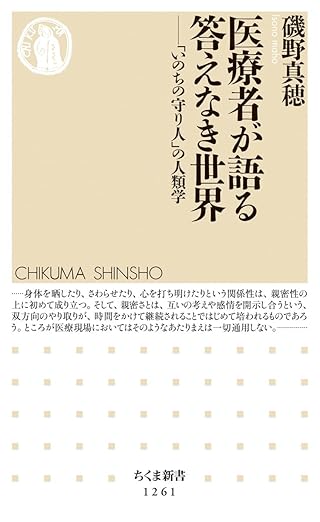
Publisher:Chikuma Shobo. Tokyo
Preface
*(Translated from the original Japanese edition)*
Clothes come off. Nakedness is exposed. Hands are allowed to touch.
Someone sticks a needle into your body and fastens devices onto you.
You speak, in detail, about the secrets that belong only to you.
In the course of ordinary life, is there anyone for whom this would feel normal—anyone you could do this with, or anyone you could let do this to you without flinching?
To be able to show one’s body or to share one’s deepest secrets presupposes that the individuals know each other well and care for one another. Therefore, when we disclose our bodies or our innermost thoughts to someone without that connection, we feel that something is “off.” Letting someone touch your body or allowing them to see inside your mind requires intimacy.
Yet, there is one place in our everyday lives where this happens—routinely, and with a complete stranger.
That place is the medical setting.
In the medical space, we overturn what counts as “ordinary” for us—easily, and entirely.
With hardly any hesitation, we undress and let our bodies be touched. We lie quietly on the bed even as multiple unfamiliar suction cups are attached to us (this is an ECG). We endure, without protest, the pain of a needle entering our skin and an unknown liquid being delivered(this is an injection). We confess, in detail, secrets we have never told anyone else (this is psychotherapy).
Even more interestingly, this exchange is profoundly one-sided. The person to whom we show our bodies, allow touch, and share our private lives (the medical professional) never shows their body to the same degree, allows the same touch, or speaks about their own private life in return.
A relationship in which one exposes the body, permits physical contact, and opens the heart is only possible on the basis of intimacy. And intimacy, surely, is something cultivated only when a two-way exchange—where each person discloses thoughts and feelings to the other—continues over time.
Yet, in the medical setting, none of that “ordinary” logic applies. Here, with no intimacy cultivated at all, we disclose ourselves unilaterally. And then, astonishingly, we even thank the other person and pay money for the privilege (the consultation fee), an arrangement that is additionally supported by government subsidies (national health insurance).
A strange space: an environment where actions permitted only in intimate relationships are allowed, and where the exchange is always one-way. That is the medical setting.
The purpose of this book is to depict what the people who inhabit this strange space—the people of the medical workplace—feel, think, and how they live within it.
***
My discipline is cultural anthropology.
Put simply, cultural anthropology is the study of the many different cultures in the world. The common image of an anthropologist is one of going deep into the interior of rain forests, living alongside “primitive peoples,” being attacked by swarms of insects, writhing in pain after eating strange foods—enduring all manner of hardship while documenting how those people live.
So, when I say that one of my research fields is the medical setting, people are sometimes surprised. “That can be a field site?”
Certainly, a medical workplace—full of advanced technology and people trained in specialized knowledge—seems far removed from anything “primitive.”
And yet, as I described above, the medical setting is a “strange space” where things that would be impossible in ordinary life are permitted, one after another.
So, what do the people who make this strange space their everyday world see there? What do they think? How do they spend their days?
As a cultural anthropologist whose field is medicine, I have been fortunate enough to encounter moments in which I could listen to the diverse voices of medical professionals.
An internist who, after a patient left the consultation room shaking their head at every piece of advice, murmured: *”If they won’t accept anything I’ve thought through with all my effort, it hurts me too.”* A nurse who, while being shouted at repeatedly by a son—because their parent, living with dementia and unable to move their limbs well, was not being cared for properly during hospitalization—spoke with a voice brimming with frustration: *”What, then, are our efforts even for?”* In the medical workplace, there are voices patients never hear.
When we become unwell, we grow absorbed in ourselves—and we easily forget that medical professionals are human beings, just like us. Medical professionals themselves may not necessarily want to be viewed by patients as individuals. But still: they are human beings.
Let us, for a moment, remove the boundary—usually impossible to cross—between “medical professional” and “patient,” and try to look at the medical professional as a person.
Behind the role called “medical professional,” what kind of person is there, really?
Reviews & Interviews
Seiji Saito / The Science of the Mind
Ren Inaizumi / Yomiuri Shimbun
Watanabe Toshiko / Weekly Bunshun
Saitetsu Takeda / Weekly Gendai
Interview
Share this book