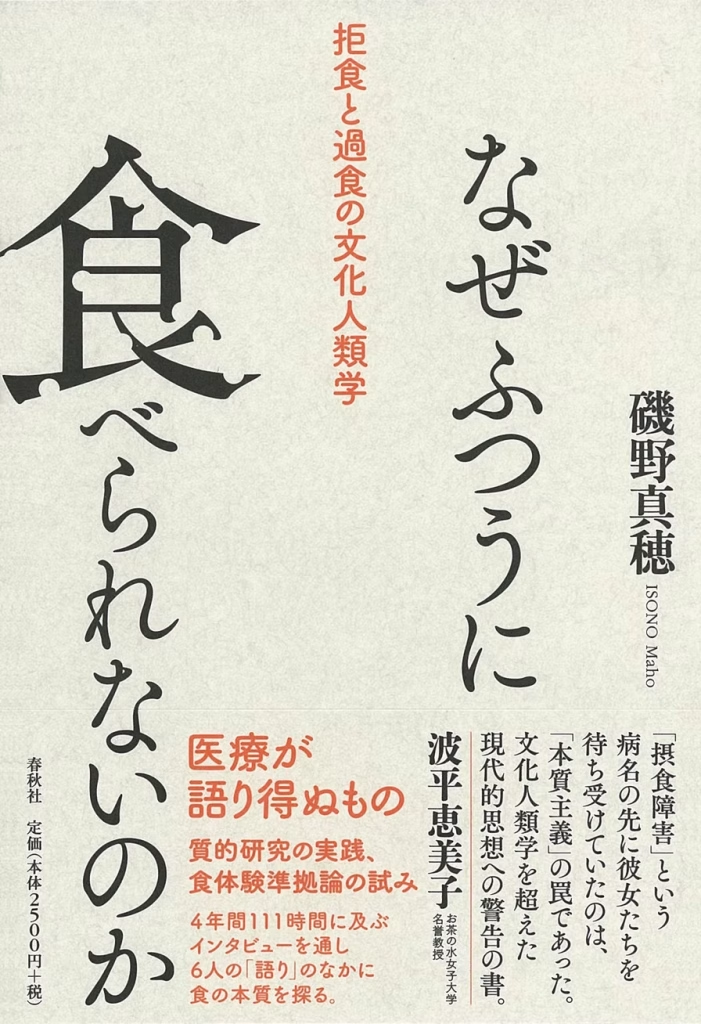
Publisher:Shunjusha,Tokyo
Awards
-
🏅2016 Institute of Ars Vivendi Encouragement Award (Ritsumeikan University)
-
🏅2017 Young Researchers’Encouragement Award, Japanese Society of Transcultural Psychiatry (JSTP)
Overview
“I’ve never once thought food was delicious.” A casual remark like this—spoken by one of the people who generously cooperated with my research, Sayuri Muto (a pseudonym)—ended up shifting the direction of my work and, ultimately, taking shape as a single book.
Where most previous studies on eating disorders have focused on identifying causes and searching for ways to cure them, this book deliberately refrains from treating eating disorders straightforwardly as an “illness.” Instead, it focuses on portraying how people living with eating disorders understand food, and how they experience eating in their everyday lives.
This approach proved fruitful. People with eating disorders told me that the book described exactly what they had lived through, and psychiatrists and clinical psychologists have also used it as a resource in their practice. Despite being an academic book, it went through seven reprints.
Another distinctive feature of the book is that, drawing on fieldwork in both Japan and Singapore, it shows that—even when the “same” illness is at stake—interpretations of its causes can differ markedly across contexts.
In Japan, there were many arguments that sought the cause of eating disorders in mothers’ childrearing practices, borrowing from classical Western debates that would later be discredited; importantly, these ideas were often internalized by people living with eating disorders themselves. In Singapore, by contrast, mother-blaming accounts of eating disorders were rarely taken up. Instead, a widely shared view was that the “Westernization” of society might be driving the rise of eating disorders.
My analysis suggests that this contrast reflects broader political-economic and sociocultural differences between the two societies: Japan’s postwar economic growth was closely tied to a thoroughgoing gendered division of labor, whereas Singapore developed infrastructure that enabled both men and women to work outside the home, while outsourcing much domestic labor to migrant domestic workers—particularly women from the Philippines and Indonesia.
Realizing that apparently neutral etiological narratives are shaped by social forces has become a backbone of my subsequent research.
Still, the road to publication was far from smooth. In the beginning, multiple publishers turned the manuscript down, and getting it into print took considerable effort. In that sense, this book taught me—through direct experience—how unreliable other people’s evaluations can be, and I continue to draw on that lesson today.
Book Review
Chizuko Ueno / Kumamoto Nichinichi Shimbun
Psychiatrist Ichiro Kumagai / Kyodo News
Izumi Murata, Representative, Akari Project / Bricolage, a Caregiving Magazine
Interview
Share this book